Showing posts with label book study. Show all posts

Wednesday, July 3, 2013

Said the Old Preacher to the New...

"An old minister once said...to a young preacher, 'Young man, you are called to this church not in the first place to make so many pastoral calls, or to preach so many sermons, but to live among the people the best life you can.'"


--Walking as He Walked by Arthur C. Zepp, 1912, 
p.127

Sunday, June 30, 2013

Clearing out the Garage

Yesterday was the last of my month-long sabbatical. I finishing it by clearing space in my garage, tossing out old projects and items, many of which should have never been brought into the garage. The idealist in me over-commits: "Oh, I could make something out of that, or use that!" Looking over all the stuff in my garage, I could see and feel the weight of all those unfinished projects and promises.


Sometimes what happens on the outside mimics and feeds what's happening on the inside. Letting go of physical stuff can help us let go of emotional and spiritual weight, too.

More than catharsis, it's about narrowing and focusing our time, talents, resources, and energy to be more effective in a few areas, rather than dabbling and never finishing or even starting a thousand other things.

This branches from earlier posts about being content. Discontent with ourselves, current situations, or others leads some to amass stuff, projects, committees or responsibilities. I think at some point discontent grows in proportion to the unused stuff, unfulfilled hopes, and unfinished projects we've collected. There's more to worry over, too many times and ways that we feel we've let ourselves or others down.

More than likely, others around us have moved on. They don't need to carry our baggage. Have we moved on? We can. By letting go. There many things worth doing, worth time and energy, but maybe not our time and energy.

There are quite a few things I have enjoyed doing or building in my garage, but what has fed me more than anything else? Painting. However, I let other things to move into my "studio space" in the garage, thinking it would only be a few weeks. Instead, I should have used that intrusion as a reason to say "no" to the added stuff and projects.

In life, protect what's most valuable by giving them most of your time, energy and space. That includes your faith in and worship of God, your family, and physical, emotional and spiritual health (and, depending on individual deficits, not necessarily in that order). That means letting go of some plans, good ideas, responsibilities, and even some marginally fun hobbies.

Right now, I'm reading The Power of Less, by Leo Babauta. He describes habits that can help de-clutter our lives in terms of time and energy. I'm only a few chapters into it, but looking forward to working on some of his suggestions! If any of this rings true for you, this is my recommended summer reading.

Blessings!

Tuesday, June 25, 2013

Content ≠ Complacent

I've blogged a couple of notes from The Little Book of Contentment by Leo Babauta. In the last section of his booklet, he answered FAQs. It's clear that people's greatest fear of being "content" is that they will lose their motivation to achieve or succeed.

Aren't we driven by competition with others or by dissatisfaction with the status quo? If we're "content," why bother? Babauta lifts up two things that continue to motivate him: 1) his desire to learn, and 2) his desire to help. He has found that he is a more successful learner and helper from his base of contentment. Even when content, we still "want" to learn, to have relationships, and to help.

As Christians, we can start from a base of grace: God's forgiveness and acceptance, his unshakable claim on us. In other words, when I know that I'm okay, then I can focus on the needs of others and on creation.

And I believe our curiosity, about others, about creation, about anything, in the context of our relationship with God is a way to love, honor and worship him. He loves our curiosity. He made us like that! (Maybe because God is curious?) Babauta's second mantra is good: "We are all learning." I'd include the arts and musical expression in that exploration and curiosity.

Still, I believe in a certain amount of "discontent" in the area of God's justice and love. Jesus wasn't always "content." Scripturally, it's about making sure the widows and orphans are not neglected, that the vulnerable in our society, including the sick, outcasts, foreigners, prostitutes, etc., are cared for, that they are included and seen as a part of the whole. It's about wanting others to know that they are loved by God and by Christ's followers. It's about meeting needs, and about wanting to share his love and grace with those that don't know it, believe it, or feel it.

God's passionate discontent in us may help us to see pain, unfairness, or suffering, and to respond with our own tears and actions.

However, yes: this all stands on a firm base of contentment within myself. "I" am okay. "I" can decrease, so that "he" might increase. I and my needs, fears, wants, etc. can decrease, so that God and the needs of others, or of exploration and discovery in creation, music and art can all increase.

Saturday, June 15, 2013

We see in the mirror... dimly.

Last night my wife and I saw the new Star Trek movie. I confess that I occasionally covet the persona of Captain James T. Kirk, ...well not everything about him, but the bravado, swagger, luck, charisma, strength, authority, etc. What if I had those best parts of his character?   hmmm...

Even people who--on the surface--seem confident and content can harbor a degree of disappointment and discontent: with themselves, with their lives, what they've done, or where they are right now. We may try our hardest not to compare ourselves to others, or to the caracatures of the ideal person we wish we could be, but it happens. We do compare or fantasize what it would be like if only we had that body or ability, charm, wealth, lack of baggage or fears... and then with those thick glasses we look in the mirror. To varying degree we feel let down by the person we see.

And there may even be an imagined god, an internal voice, who looks over our shoulder at the reflection with us and, scowling, whispers his accusing judgments into our ear. "Look how you fail me. You call yourself a Christian?" We don't measure up on any scale to the person or life we "ought to" be or have.

"...In reality, no one you see is what you think they are — you only see certain parts of the story, the good parts, and rarely see the person’s doubt and anguish and discontent. People don’t share their warts and hemorrhoids, just the great pictures of their food and vacation and children."
-Babauta, Leo (May, 2013). The Little Book of Contentment.

These comparisons may motivate us for brief moments to strive for what seems healthier living, exercise, organization, better habits, etc. Occasionally, we gain some victories and have those moments of "yes" only to place the bar a little higher, find some other flaw, or backslide into the old self. These comparisons, that demeaning internal voice, and any scale of how we "ought to" be, look or act are distructive lying demons.

Contentment isn't achieved. Contentment is accepting the reality, but not just the disappointing "reality" we see in that mirror (because that image is false; it has been warped and smeared by those lying demons). Contentment is accepting the greater reality of who God sees when he looks at each of us. Contentment is accepting and trusting the amazing forgiveness and ability to redeem and act and heal through us, to breath, love, laugh, help.

The Little Book of Contentment: "Contentment is about letting go of these fantasies, and realizing that life is amazing without them. People around us are amazing without the fantasies. We are amazing, without the fantasies. How do we let go of the fantasies? First by shining the light of awareness on them. Watch ourselves fantasize, realize that it’s happening, realize that we don’t need the fantasies. Be OK with letting them go. Watch reality closely, and recognize life’s awesomeness, as it is, without the fantasies. It’s there. We just need to learn to see it."

If we could only truly see with the eyes of God, like Jesus, who looks at us and sees beauty, someone he forgives--not only because he's merciful--but also because he loves us more than we love ourselves. When content, we can see with his eyes. It takes trust and practice to take off the thick smeared glasses of lies and false fantasies, and use his eyes to see ourselves, others, and creation.


Contentment, by the way, is not complacency. We can be content AND develop healthy habits, as well as learn, grow, help and even achieve. ...More on that later.

Thursday, June 13, 2013

Contentment

I am very grateful that my congregation has a sabbatical policy for the pastors, offering up to 3 months every seven years. While I am two years away from my next opportunity, they were especially kind to advance me one month now. I was going to take a two-day course at Pacific Lutheran University, but the cost was a bit high. Instead, I am laying out a course of exercise, yard work, and self-study.

Last night, I read a short book about being content. It took a little over an hour, including time for reflection.

Now, this was out of the Zen tradition, and--at least for me--needs translation. Leo Babauta finds his contentment and value within himself. However, what I need is to trust that the God of creation looked at his creation (including me) and found it good; he created and sees value in me, a work of his own hand. God sees enough value that he is willing to reside within me through his Spirit (a promise of my baptism) and through Christ he was willing to use his own life in order to claim and keep me. Babauta says that we won't find this contentment and value from external sources. I think he's right that we won't find it in the "world" outside of us. However, I believe that intrinsic and internal value and--therefore, true contentment--got its start from a much bigger source than myself. That Source makes my value, and potential contentment, all the more stable, reliable, and (God help me) believable.

With that perspective, I did find the words and activities helpful for self-acceptance, and for dealing with negative emotions - my own and others'.


Here's a first nugget:

"If you have a friend who is constantly late and breaking his word, not showing up when he says he will, eventually you’ll stop trusting that friend. It’s like that with yourself, too. It’s hard to like someone you don’t trust, and it’s hard to like yourself if you don’t trust yourself."

The suggestion is to take small steps toward regaining trust in yourself. Make a very doable promise to yourself, and keep it, and then another.


The Little Book of Contentment by Leo Babauta. (May, 2013; It may only be available in digital form. You can click the title above or download the .pdf version for free.)

I'll post a few more nuggets in days to come from this little booklet, but I've also started to read his print book, The Power of Less; The Fine Art of Limiting Yourself to the Essential...in Business and in Life. I saw it on display at our denomination's regional assembly. It reminded me of a very helpful book, Simple Church, which I read a few years back.

Saturday, September 13, 2008

Last post...

This web blog describes my experiences, readings and thoughts during my sabbatical from June 1 to August 31, 2008. You can view them by using the archive menu to the right. (If you click on the triangles to the left of the dates, it will give you that week's list of post titles.) Or, you can click on one of the post labels below, i.e. "pictures," "book study," or "sabbatical reflections."

In either case, posts run from the more recent to older posts.

Once I start a new blog with a new title, I will let folks know the address, etc. when it's up and running!

Monday, August 4, 2008

Book notes: A Sense of the Sacred, pt. 4 of 4

To finish, I'll list a few quotes of advice that Seasoltz offers churches in art and architecture.

"The best artists should be comissioned to appoint liturgical spaces...Like the architects, they must be willing to dialogue with their clients and should see their role as one of ministry in the community.
"Budgetary limitations should not necessarily determine what is to be built and appointed. A master plan should be created so that long-range projects can be envisioned. The great Romanesque and Gothic cathedrals were not built in a day; likewise, parish plans should be developed always with the future of the community in mind" (p. 271).

Among other points, Seasoltz says the "Rationale" must be clear:
"When a piece of art is commissioned for a church, both the commissioner and the artist need to know why the work is being comissioned. Is it because the pastor and the community want to enhance the liturgy and the setting for worship or because they want to inspire...the faithful by enriching the church environment? Or is the work being commissioned because a benefactor...wants to give money to the church for a particular project?

"Form and space. ...How will each and every aspect of the work fit into the whole liturgical or devotional context?

"Purpose and function. ...How will the work enhance the litugical worship of the community and promote the life and goals of the church? How will it encourage the community to be a eucharistic community? How will it facilitate the preaching of the word and the celebration of the sacraments? How will it promote the devotional life of the community in such a way that their devotional life is consonant with their liturgical life? How will the work challenge and rightly confront the community, which might be indifferent, lethargic...Unlike much of modern art, which often communicates a political message and functions as propoganda, art placed in our churches should be in keeping with the gospel" (pp. 341-342).


Well, that's enough history to suit me for a while! I wish I could hold in my head all the distinctions re: Romanesque, Gothic, Renaissance, Baroque, and which artists and architects belong to what time period, and how this or that work typifies what... etc. Don't quiz me! But I do feel that I got a lot out of this read, anyway. I'm also glad to be finished!

Saturday, August 2, 2008

Book notes, A Sense of the Sacred, pt. 3 of 4

I finished Seasoltz's book, A Sense of the Sacred, yesterday morning.
I enjoyed this little exchange from the early liturgical community movement in the early 19th C.:
"Through [Nikolai] Grundtvig's efforts, the eucharist once again became the regular form of worship in the Danish [Lutheran] church, celebrated twice every Sunday and on festivals. He successfully integrated the products of the folk arts and crafts into the worship of the people by incorporating their weavings and carvings into the worship space, and...included songs and dances. He also revived the liturgical year and wrote hymns for almost everyday of the church year. ...The hymns, however, were so new that they aroused opposition. ...Kierkegaard, for example, derided Grundtvig as 'a noisemaker who will be unpleasant to me even in eternity'" (pp. 198-199).
Some of Grundtvig's "noisy" hymns that we sing are "The Bells of Christmas," "Bright and Glorious Is the Sky," and "God's Word Is Our Great Heritage."


Seasoltz goes on to describe the more recent struggle of art and architecture. There were plenty of movements (i.e. the Arts and Crafts Movement), artists and architects that were at work, but the wars, eclecticism, and expense of quality work in light of mass production created a number of problems...

"Unfortunately the churches failed to make use of the most gifted exponents of the [Arts and Crafts] movement. ...Consequently church goods were regularly bought from church furnishing shops, which carried wares that were dull, pious, and inferior in quality" (p. 194).

"The decades immediately following World War II showed an ever increasing diversity in architectural styles...resulting in scattered parts often described as visual chaos...If any general architectural order existed, it usually consisted of the unimaginative, monotonous repetition of inarticulate components. At no period in human history up to that time was the human environment more problematic, nor had people felt more insecure in their relationship to themselves, one another, and their world" (p. 245).

"[This] generation of modern architects seeks a redefinition of architecture in terms of the complexity and contradictions of modern life...They agree that modernism died in the 1970s, but they certainly have not succeeded in putting any unified style in its place. The result has been what might be called architectural eclecticism, which often goes by the name postmodernism" (p.249).

Sooo... what's the solution?

"Much of the best in contemporary architecture does not concentrate its attention on fixed types or inflexible principles, but rather seeks to understand the total character of the project. The result is an architectural method rather than a style...A building is not a mere container housing functions; it is also an expressive presence that is dynamic in the environment. ...Buildings...have their roots in the past, relate to the present, and reach out to the future" (p. 250).

Throughout the book, Seasoltz illustrates the periods and his points with specific artists, architects, art works and buildings. I'll list a few from the 20th C., and add links as I find time.
Note in the art pieces, the frequent use of the artists' own environment...connecting the story and message to this place, or these people.

Saint James Cathedral in Seattle WA, esp. the font, altar and reading areas. (Seasoltz adds: "The renovation and renewal of this cathedral are eminently satisfactory" (p. 275). That's high praise coming from him.)


He illustrates the frequent theme of loneliness and isolation in postmodern art (which is a frequent ache in contemporary life) with Roderick Barrett's painting, Players.

Religious concepts:

Georges Rouault (1871-1958) and his variations of Jesus as Suffering Servant in the Miserere series.

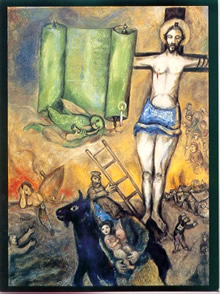
Marc Chagall (1887-1985) a Russian-born Jew who frequently painted with Christian themes, i.e. His White Crucifixion and Yellow Crucifix, painted in the 30's and 40's. connecting the suffering of the Jesus with the suffering of Jews at the hands of the Nazis.

John Perceval's Christ Dining in Young and Jackson's.
Margaret Preston's Australian pieces: Adam and Eve in the Garden of Eden, The Expulsion, and Christ Turning Water into Wine.
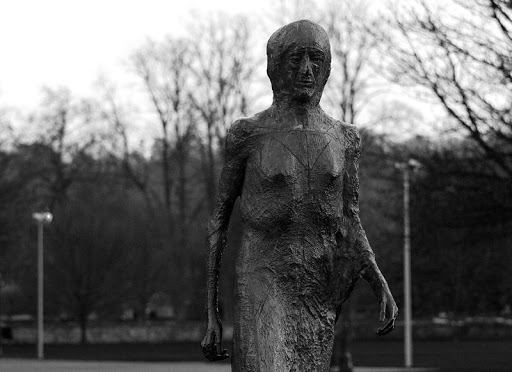
Elizabeth Frink's Walking Madonna who strides from the church property back into the community.


That's more than enough. In the last of these four blogs on Seasoltz's book, I will mention some of the advice he offers to churches as they consider art for their congregations.

Thursday, July 31, 2008

Book notes, A Sense of the Sacred, pt. 2 of 4

A few interesting notations re: liturgy.

In many churches (and in the older tradition) the baptismal font is either in a separate space, or somewhere near the entrance to the worship area... symbolic of baptism being an entrance into the community. At a baptism, the congregation would start the worship by gathering around the font, then move deeper into the space as worship progressed. It was moved to the front by many protestant congregations, esp. in America, so that people could more easily remain in their seats and watch.

Seasoltz adds this neat tidbit: "Certain aspects of the baptismal ritual symbolically enacted the Adam and Eve typeology. The ritual often included a renunciation of Satan while facing the West, after which the initiates faced the East, the direction of Eden, to proclaim their faith" (p. 116).

This bold gesture is liturgical "orientation" - literally, to "find east." The sun rises in the east/orient, so that looking east is also a reminder of our salvation, and our final destiny with God. The above movements mean that the baptismal party renounces the devil and evil as they face west: the back of the church, or the old life from which they are coming. Then, they they turn toward the east; they are orient-ed toward the front, the traditional space of the altar and the promise of resurrection, in order to proclaim their faith in God the Father, the Son and the Holy Spirit.   
(In our congregation, the altar in the sanctuary is nearest the south wall but, when you step into worship spaces, the direction the congregation tends to face when looking at the altar becomes the "liturgical east.")


Speaking of altars, I didn't realize it was this early, but the altar was moved to the further end of the east apse and hidden from the congregation by means of a rood ("cross") screen as early as the 700's, beginning in France and Spain. During communion, the priests would disappear to the altar to quietly pray over the elements before coming back out for the distribution. The words of institution, blessing and raising of the elements "became veiled in special mystery... [The priest] alone was deemed worthy to enter into the mystery, while the rest of the people were left to pray silently at a distance from the sanctuary" (p. 122).  
Hmmm... can you imagine if someone got the giggles in that atmosphere?

About this time "was the introduction of the communion rail...[and] the gradual change from the use of leavened to unleavened bread and the decline in communion under both kinds [i.e. they might distribute the bread only]. The increased sense of unworthiness among the faithful, together with a growing sense of reverence for the Blessed Sacrament, brought about the use of small, thin, round wafers, which could be distributed without crumbs. They could easily be placed directly on the tongue, rather than in the hand of the communicant. Later, ...the faithful began to receive communion while kneeling rather than standing" (p. 123).

It does show, however, "the way we've always done it" was--at one time--an innovation, and "new" practices are frequently a return to even older traditions!

Book notes, A Sense of the Sacred, pt. 1 of 4

I've made mention of it in the previous blogs, but I'm just over two-thirds through R. Kevin Seasoltz's A Sense of the Sacred; Theological Foundations of Christian Architecture and Art. It's a challenge, especially for someone like me who has never really studied art or architecture, and a poor head for retaining history on top of it. Regardless, I have simply slowed down, reading one-two chapters and day, and am learning quite a bit about the shifts from Romanesque to Gothic to Renaissance, Baroque, etc. Even more helpful have been the connections Seasoltz makes between these general artistic and architectural styles to the shifts in theology, which affected the liturgy, the emphasis on clergy or the community, and the participation (or lack of it) of the congregation.

Some things worth noting...

From the start and in most periods, when illustrating or making Biblical images, artists did not try to imagine and dress the people and environs "as they must have been." There has rarely been a concern re: "historical accuracy." They usually drew from their own environment and life. An important exception would be the periods of renaissance when artists would return to study and imitate the classical Greek and Roman styles. In the earliest Greco-Roman Art, "Daniel was represented as a heroic nude; the prophets were shown in philosophical garb; and the altars in the scenes of Abraham sacrificing Isaac were typical Roman altars" (p.91).

What can we draw from this? Perhaps, we would have an easier time seeing ourselves, involving ourselves in scripture if we made the effort (as many artist are) to cast these stories and imagining them in our time, modern dress and environment. Of course, much religious abstract or representative art has this in mind, but--unless trained in or sensitive to abstract art--many people are left out, and they return to the more romanticized realism of the late 19, early 20 C. 

Some people have an initial negative reaction to a clearly oriental Jesus coming from eastern art, or the African images of Mary coming from S. Africa or African American culture. We tend to so closely associate "truth" with "historical accuracy" that we dismiss the more important truths which come out of metaphor, symbols, stories. (In truth, none of the images we hold or cherish are historically accurate!) Re-imaging isn't so much about trying to re-make or pretend that Jesus, or Mary, or others actually looked like us, as it is learning and trying to see them embodied, or applied to our life and situation. Or, we may be trying to cast ourselves and world into the Bible story. How is this story or image still true for us?

Seasoltz mentions some of the early fauna used in funereal and churches to represent resurrection, "including the dolphin, the phoenix, and the peacock ...[which] do not appear in any specific bible texts." Instead, these came from popular myths and stories applied to the Christian perspective, i.e. stories of dolphins carrying drowning victims to safety (p.112). In the Northwest, how might the salmon and its life-cycle or native stories about the salmon do the same? How does the rhododendron compare with traditional Christian images and use of flora? What if Mt. Rainier and locals were used for the scene of Jesus and the disciples returning from the Transfiguration?


Monday, July 14, 2008

Book notes: Walking As He Walked

I had started reading Arthur C. Zepp's Walking As He Walked some months ago--and even quoted him in a sermon. I finally finished it during the flight to the States. He published it in 1912 as a reaction or response to two groups of relgious leaders: 1) those who stormed into town with fiery, motivated sermons, but then stormed away to the next town without suggesting or making the connection to a believing, worshiping body, and 2) the believing worhiping bodies who seemed to think that faithfulness is only about attending church once a week, reciting or canting the words put in front of them, and listening passively.

Zepp was a part of the multi-denominational "Holiness" movement which sometimes took the notion of sanctification to a uncomfortable, legalistic level--i.e. If you ain't livin' like thus-n-such, then you ain't really in it, and the Spirit ain't alive in you. Nonetheless, I often find great kernels of wisdom and a better sense of faith and trust in God's grace by challenging myself, because it's true, salvation aside since that is based on God's grace alone, I pray that the Holy Spirit's fire can be fanned within me, that it will change me and that I can be a better agent in his world!

Here's a few good quotes:

"A fanatic, at his wife's funeral, arose and said: 'I want to testify, I have gotten so far along I do not feel grief now.' The pastor dropped his head, as if in brief meditation, then suddenly looked up and said, 'Brother, go home and ask God to forgive you!' Amen. God wants none to get so far along!" (p. 22). Jesus was a man of sorrows; he walks with us and hallows our sorrows.

"Aggressive Evangelism Committees, Conferences, and Forward Movements...get together and discuss, discuss, 'how,' and 'method,' and 'ways' and 'means' of doing his work... The power of God would be present if half as much time were spent in humiliation, heart searching, surrender, and prayer, and faith for it, as is spent in discussion, suggestion, and debate" (pp. 73-74).

"An old minister once said...to a young preacher, 'Young man, you are called to this church, not in the first place to make so many pastoral calls, or to preach so many sermons, but to live among the people the best life you can" (p. 127).

Saturday, July 12, 2008

Book notes: A Sense of the Sacred

I'm about a quarter into R. Kevin Seasoltz's A Sense of the Sacred; Theological Foundations of Christian Architecture and Art. I'm a little surpised--happily. As the title suggests, it's a more scholarly book, and I was a bit intimidated. There are some pretty heady sentences like this one:

"The model takes the incarnational principle seriously; it seeks to draw out the implications of Christ's consubstantiality with human beings in terms of intersubjectivity and the personal encounter between human beings and Christ" (p. 44). Wow. I'm glad he takes time to explain and unpack statements like that!

Luckily, there is much that this historical look at art and architecture helps explain.

In positive terms, here's how he describes these generations' approach to growing in faith: "This strain in postmodern culture is characterized by humility, which acknowledges that the human grasp of truth is always partial. Both human persons and communities are fragile and finite; hence, their discourse about themselves and about God must be tentative. This does not mean that truth is relative; it means that the human grasp of any revelation about God is open to the possibility of further revelation, understanding, and clarification" (p. 31).

Taking the example of documents that came out of the Second Vatican Council, he writes, "The church is described in terms of a rich complex of images...It is the people of God, a holy communion, the body of Christ, and the sacrament of salvation. What is important for architectural purposes is that the emphasis has shifted from a pyramidal image of the church dominated by a clerical elite to an image of the church as an assembly" (p. 43).

He writes about how liturgy and liturgical art can come together, responding to the deep longings and searchings in postmodernism:
"Jesus died to the human tendency toward isolation, self-centeredness, and self-preoccupation. He inserted himself into the human community and entered deeply into the healing and corrective dimensions of human life. Through the outpouring of the Holy Spirit, he empowers us to do the same" (p. 55). These connections between each assembly and God, and between each assembly and the community in need must be made explicitly and incarnated through their liturgy, their sacraments, their art and their architecture. "There is an essential link between the celebration of the liturgy and social justice and ethical behavior" (p. 59).

The struggle with liturgy and art, Seasoltz realizes, is that it often calls people to dig deeper and to reflect on more than the surface. "Living in a technological environment, people do not easily develop a contemplative disposition that enables them to interpret experience on deep levels and to look beneath the surface of events" (p. 59). It is the the church assembly's responsibility to provide the adequate time, space, words, gestures, silences, images, art and architecture to encourage and guide people to this reflection, for there we can find healing and the motivation for meaningful activities. We must teach people to be open to transformation: "They must be willing to enter into the symbols and to expect transformation to take place...Liturgical celebrations must be accompanied by a reflective or contemplative disposition and a life of personal prayer on the part of those who participate. The dawning of understanding and the disclosure of fresh meaning usually come gradually and often unpredictably to those who do involve themselves in the symbols and who spend time with them" (p. 61).

Book notes: Canterbury Tales


I enjoyed re-reading Geoffrey Chaucer's Canterbury Tales, even though we decided not to take the day trip out to Canterbury...just not quite enough time. Several of the stories are pretty bawdy, but his intension was to offer it in satire and irony.

His feelings about women's social roles and rights are surprising, given that he was writing in the 1380's and '90's. Through the character of the Wife of Bath, he lifts up and criticizes all the mixed conflicting messages that are expected of, written about, or preached to women.

After the Cleric tells a tale about Griselda, who allows herself to be tested and tormented by her husband for many years, Chaucer breaks into the flow of the tales through the words of "Chaucer's Envoy" who says, "Oh, noble wives, full of high wisdom, let no humility nail down your tongue...Don't be hoodwinked in your innocence; take the control into your own hands. Engrave this lesson deeply in your memories, for it will work to the common profit of mankind. You wives, strong as big camels, stand up for your own rights; don't allow men to do injustices to you. And weak wives, feeble in battle, be fierce as a tiger yonder in India."

To bring all these characters and stories together, Chaucer used a pilgrimage from London to Canterbury. It provided a time and place for 20+ people of vastly different social & economic circles to come together on relatively equal footing, to tell their stories and--more important--to interact with and affect each other, primarily over the issue of fidelity and relationships. For examply, once the Wife of Bath finishes her prologue and story, nearly everyone that follows somehow references her or begs her pardon. Various characters are given opportunity to air their grievances (or insults) against the other, and then are forced to hear the other side. Normally, most of these people would not be seen interacting with one another, but here they all come under the "Host's roof and rules"--even as they journey.

This relates to something R. Kevin Seasoltz suggests as a goal of a church community: "The pilgrims leave their familiar lives behind and join for a time an egalitarian community on a liminal journey toward a sacred space or place. Following their journey, ...the pilgrims reenter society as new persons who have been changed by the experience" (A Sense of the Sacred, p. 73). Think of going to a youth or women's gathering, to a Promise Keepers' event, a mission trip, or the 3-Day Breast Cancer Walk. Besides the stated social goal/destination of these events, the real "agents of change" for each individual are the friends and strangers with whom we enteract along the way or during the event.

Seasoltz goes on, "[Similarly,] a sacred space [like a church building or sanctuary] puts people in a place that is 'bewixt and between'; it is distinct from the secular spaces that people occupy most of their lives, but it is not the final resting place where people hope to find their lasting home. While in the sacred space they leave behind the structures that often pit them against one another...Christians are gathered for penitential purposes, to acknowledge their need for the saving presence of God, and to be transformed so that they might be able to live in the secular structures of society in a way that is consonant with their calling to be faithful disciples of God and brothers and sisters to one another in Christ and through the power of the Holy Spirit" (ibid.).

Monday, July 7, 2008

Book notes: Liturgy and the Arts

Last night I finished reading Albert Rouet's Liturgy and the Arts (translated by Paul Philibert). Besides describing the relation between the two, it gave me some insight into the struggle I've seen in many artists' relationship to the church. Liturgy needs art, contains and uses art; our Lord is the true Lord of the Dance, after all. In fact, Rouet spends an entire chapter on the struggle that the church has historically had with dance (pp.123-151). Religious piety often has a suspicion of the arts--unless "properly restrained." Meanwhile, the artist values freedom of expression and is often suspicious of the constraints of liturgical or "religious-pious" expectations. "The artist is free to inovate, but not the celebrant" (p. 32).

But if the liturgy attempts to function without art and new innovation:
"A scrupulous obedience to rubrics will lead to a ritual materialism...legalistically perfect and humanly deadly, because their performance leaves no place for the present--this particular people, these human circumstances, this moment of time" (p. 11).
"We might make fun of some popular liturgical songs, but are they not a reflection of present day sensibilities?" (p. 10).
"Each celebration calls for preparation, and even requires some new composition, or else it will fall into categories of mere habit, boredom, and finally insignificance" (p. 2).

On the other hand,
"Music for the Church, whether by Rossini or by a rock group, only becomes liturgical by taking a certain distance from secular music" (p. 41).
& vs. the common comparison of liturgical worship to theater:
"Theater moves from the stage to the outside, toward spectators, whereas liturgical action comes from the outside (like a procession) to move progressively closer and closer to mystery" (p. 44).

It is within the desire for grace that we find "a convergence between the arts and liturgy" (p. 38). "If the arts...express a transcendence of the human and an attraction toward the infinite, liurgy brings to humanity a healing of its deformities and gives it the image of a splendor glimpsed" (p. 40). "The liturgical act goes 'from God's people to God's more deeply rooted people'" (p. 5).

Re: the frequent struggle with time limitations imposed on our celebrations--
"Liturgy does not go along with horizontal time. It follows the depths of time; it looks for the intensity of time" (p.63). "Busy people...[often] waste time because they don't enter deeply into the things that they do" (p. 79). "The real liturgical problem is not whether or not to do away with [clergy robes], to reduce the sermon to twelve minutes, or to finish Mass within fifty-five minutes...The real problem is how to dwell within time so as to make it exist for us as strong time. The pastor has to look for a rhythm of celebration that establishes a good usage of time" (p. 80).


Rouet is presenting a kind of theological thought process, and doesn't often give specifics. In one chapter he writes on how liturgy with art tries to help us with orientation. This was the first time I noticed that the word "orient-ation" means to "find east," or where the sun rises - the great daily natural symbol for resurrection. The art of our spaces can help us to spiritually move toward that opening that lies somewhere "just beyond" or over the altar. That's why such areas around and over the altar are often surrounded by empty space and height, a silent prayer for God to come and fill it. Other traditional sacred spaces include places where a spring flows, or once flowed, a natural symbol for the source of life, a good place for a baptistery or font.


Speaking of the font, Rouet does offer these two concrete opinions regarding the placement of font and altar:
"How can we make it clear that baptism belongs to a Christian's entrance into the life of the Church if the baptistery is found at the foot of the altar? It belongs at the place where one enters the church building!" (p. 45).
"We should be able to move about [the altar], to rest in meditation near it, to make a circle around it" (p. 44).

I think this summarizes many of the elements Rouet says are needed for beautiful, meaningful, deep liturgical celebrations:
"Liturgy is harmonization of gestures and words bound up in silence--gestures, words, and silence--shape liturgical time. Time within liturgy is not only a dramatic action, it is prayer" (p. 72).

I enjoyed the translator's bold statement: "Arts are not for ornamentation, but for evocation...to map out the location of God's presence and to detonate the sacramental potential of the world" (p.ix).

Friday, July 4, 2008

Sabbatical, Day 33


We killed our feet today...

especially since two of the major Underground lines weren't operating and we had to patch together others to get whre we wanted.

We made it to Westminster Abbey & St Margaret's. Wow, hope they don't have to stack to many more sarcophagi in there... It's getting crowded with kings and queens remains...and floorspace is prime real estate! Saw plenty of beautiful art, including images of nature.

We had lunch in the British Museum where we looked through the Egyptian, Assyrian, and Greek sculpture displays. Notably, we saw the Rosetta Stone (click) and pieces from the Parthenon. Afterwards, we had just enough time to get back to the hotel to change for high tea at the Georgian Restaurant in Harrod's (click). We then looked through quite a few of the shops, but spent most of our time in the Food Halls where we purchased items to take home for a late evening meal.
I took a jog around Kensington Park as the sun was setting...very beautiful.

Dinner in the hotel room included 2 cheeses: Red Chesire English and a Berkswell, and 3 different kinds of Prosciuto: Tivoli-Fiourrcci, Parma Ham, & Extra Seasoned Parma Ham. This was washed down by a Claret bottled for Harrod's by Maison Sichel, Bordeaux, France. All-in-all a rather European-eccletic (EU) meal.

I put aside the Borchgrave book; the illustrations are beautiful, but the writing was a bit flowery and low on history. Now I'm reading Liturgy and the Arts, translated from Albert Rouet's original French.

Friday, June 27, 2008

Book notes: SiMPLE CHURCH

Yesterday, I read through the book, SiMPLE CHURCH; Returning to God's Process for Making Disciples by Thom S. Rainer and Eric Geiger. This would be a helpful book for members of the Compelling Vision Team to read or consider.

Geiger is a fairly young pastor and author; Rainer has been writing for church growth for quite a while. They admit that this "simplifying" is not easy, especially not for established churches. I kind of wish they had put their last chapter first; it helped to read that "for some these [four] steps will take several months. For others these steps will take several years. Remember, the longer your church has been complex, the harder the transition will be" (p. 236).

The four steps are...
1) design a simple process (clarity)
This could be our elusive "purpose" or "compelling vision" that some of us at MLC are trying to discover and define. Rainer and Geiger call it "clarity" and suggest that it completes the following statement: "Disciples at our church are: ____________, ____________, ____________ and ____________" (p.237). (Limited to three or four actions/description words or phrases; and each tends to suggest a deeper or more involved level of discipleship.)

2) place your key programs along the process (movement)
Each of the descriptions of "what disciples are" should have one major church-wide "program" that helps move disciples from one level into the next. Each program might or might not have several/many subdivisions according to age groups, small group or ministry team emphases. The main point is that the purpose (vision or "what") statement is also your process (or "how") statement.

3) unite all ministries around the process (alignment)
The purpose and process defines why and how your church does ministry, what ministries get resourced, through what means new concerns or emphases will be implemented (usually through the existing programs), who and how the church recruits or hires, even what announcements are made at a Sunday service.

4) begin to eliminate things outside the process (focus)
"Some people will struggle with abandoning other programs to focus solely on the ministry process God has given your church. Some of the programs will have deep traditions and rich history. You must use wisdom in step 4" (p. 240). They state that even "successful" programs with strong leadership and good attendance may actually be causing "congestion" - using the time, space, church resources, volunteers that might otherwise be used for a program/s that more effectively help make or nurture disciples to different levels of maturity or involvement. People are longing for simplicity, and yet we are addicted to our complex lives, in and outside of the church.

Several studies have shown rather conclusively that churches do "less" better than "more." The more "complex" a church is--the more programs, special events, unrelated small groups or ministry teams, etc.--the less likely they are to grow or thrive in their communities.

Here's Rainer and Geiger's definition of a "Simple Church": "a congregation designed around a straightforward and strategic process that moves people through the stages of spiritual growth" (p. 60). Later, they expand on this by adding: "The leadership and the church are clear about the process (clarity) and are committed to executing it. The process flows logically (movement) and is implemented in each area of the church (alignment). The church abandons everything that is not in the process (focus)" (pp. 67-68).

This book kept me up late, both in the reading and turning it over and over in my head. The last couple stages are obviously the difficult ones. I was reminded of a number of years ago when I began to develop a Disciples 101 thru' 401 series to support both our Mission Statement and Marks of Discipleship, then a series of brochures that assigned the various ministry and program opportunties according to each of words of our mission slogan: "Gather, Grow, Glorify, and Go!"

Attempts like mine to use and adapt other resources and systems, along with churches that have several or many different mission statements, slogans, etc., are all the symptoms of complexity that this book is addressing. There is much to learn from their study and four steps. The identity marker at MLC that causes me hesitation: we are still a community center... for many folks and groups in and outside of the congregation. But, perhaps, there is a way to address it within our vision/purpose.

I have been thinking about all of my reading so far this summer, and am beginning to have some thoughts about how well our sacraments may fit and flow in describing our purpose and process. I've been sketching out my thoughts on paper, but this blog entry is long enough; I don't want to make it any more complex. maybe in the next week or two...

Monday, June 23, 2008

Book notes: Re-Pitching the Tent

I just finished Richard Giles's Re-Pitching the Tent; Reordering the Church Building for Worship and Mission. Excellent. It is a handbook for churches considering light to heavy refurnishing, remodeling, or restructuring... esp. in light of litugical renewal. (He calls it "re-pitching your tent.") He emphasizes the liturgical core of Baptism, Word (Reading and Preaching), and Eucharist (Holy Communion) as the points around which a congregation should build, emphasize and furnish.

Other issues he picks up include the place and use of music and musicians, prayer chapel, use of facilities for caring for/nurturing our community (being "neighbor"), the prayer chapel and gathering spaces.

He emphasizes the historic, and even literal "movement" of the worshiping body, from the Baptismal font (our entrance into the Body), to the Word (Bible and preaching), to the Eucharistic table (we receive nurture and our mission). In most of the illustrations and descriptions, these symbols are not all placed or clearly divided from the worshiping body, but in their midst; the people gather around them, or progress through them.

In our case, the sections re: use of art (ch. 15 & Appendix B), the exterior, entrance and gathering space (chs. 19-21), the prayer chapel (ch. 25B), the music (ch 26), and community use (ch. 27) seem more immediately helpful. Much of the rest seemed more helpful for large churches doing a complete remodel or refurnishing of their worship areas, or smaller congregations with adequate space.

But the rest of the book is important for casting the need and value of re-pitching our tent.

There are many underlines in my copy. I will type six quotes below, but for those of you in my congregation, I will leave my copy sitting on my office desk. If you borrow it, let one of the secretaries know and send an email or leave a note for me on my desk!

"The experience of re-pitching our tent has reinvigorated the comunity of faith with a dependence upon the mercy of God and a loving intimacy with him in his power and provision" (pp. 20-21).

"If...we stop in our ceaseless activity to listen afresh to what the Spirit is saying to the churches, we may hear his voice telling us to enjoy all that we are and all that we have (buildings included) but to do so with a new detachment appropriate to a Church facing unparalleled difficulties in the Western world" (pp. 51-52).

"Because the re-ordering of a church building, treasured for its familiarity and its memories, requires of us a great deal of letting go, a costly act of surrender, it can be for us a powerful sacrament of God's re-ordering of our whole lives" (p. 63).

"What is your church's message?...is a question that every Christian congregation should ask in relation to its own building...The church's building is a commanding preacher, and no one should underestimate its power to communicate...Buildings, no less than people, have a body language; to quote Ralph Waldo Emerson, 'What you are speaks so louldly I can't hear what you say'" (p. 103).

"We should never be pushed into muddled half-measures; any re-ordering we undertake should display a striking clarity of liturgical purpose arising from sound theological principle" (p. 116).

"Above all we must return to the primacy of the assembly as an icon of Christ. No matter how beautifully and carefully designed a worship space may be, it remains an empty stage until the cast has entered who will bring life to the words of the story" (p. 117).

Friday, June 20, 2008

Sabbatical, Day 20

This is the third day this week that I've managed to take a jog with Trevan and Katy-dog (who seems very happy about it.) Trevan, who is normally very serious and quiet toward strangers, was greeting many of the people we passed with his "Gabba-gabba-gah!" He's also started to say "OOooh--kay!" with the wonderful, exagerrated facial expressions that I've been trying to teach him. We did some grocery shopping and ate at Applebees. (Apparently, a man alone with an infant attracts attention and welcomes conversation. Do we really look that odd or helpless? Granted, being different races, we proabably do attract even more attention.) Trevan seems to be enjoying this one-on-one time. I am. But I do miss Pauline and Mac.

They are doing well in Montana. They are dividing time between my side and Pauline's side of the family. Today, Gramma Shanks and Pauline took Mac to the Children's Museum (which is quite a bit bigger with more to do than here in Tacoma... cheaper, too). There was a child's size baketball hoop that Mac wouldn't leave until he had mastered.

On the book-reading front, I'm about half-way through Richard Giles's Re-Pitching the Tent; Reordering the Church Building for Worship and Mission. It has been a better (and easier) read than I'd expected. It is an especially good book for a church that is just about to rebuild or remodel.

His point is that many churches need to "re-order" their bulding, interior design, or spaces--not just to stay "hip"--but to remember that "a wandering Aramean was my father." He shows that, from the beginning, whether we have tents or buildings, the structure must serve the message--no, not just the message (theology and teaching), but the transmission of that message (evangelism)! and its accompanying mission.

Older (biblical) models of house-churches or preaching sights, together with centralized gatherings may be worth more serious consideration, and more use. As Jesus and the apostles spread the gospel, they met in homes, local synagogues, the Temple or community-meeting places. I have been less impressed lately with the way we tend to define a "church" body-- i.e. self-sufficiency. The Bible clearly suggests something different.

Giles is often writing from his British experience, but he includes and applies his insights to his American audience; we are dealing with many of the same issues, especially here in the Northwest. I may have over-done the book-quotes in previous blog entries (and I will again), but I'll end with this one:

"It is the people of God themselves, assembled for prayer, who together form the primary icon of Christ among us. We no longer gather merely to gaze at Christ the image of God; in the renewed liturgical assembly we enter into the mystery of becoming Christ....We recapture the New Testament vision of the entire Christian assembly as the holy, priestly community called to offer worship. There are to be no more spectators, for in the eucharistic action all the faithful are ministers and celebrants of God's inexpressible gift" (p.83).

Tuesday, June 17, 2008

Book notes: Eat This Book by Eugene H. Peterson

I finished Eugene Peterson's Eat This Book a couple hours ago. It challenged me along the way, but as I read he addressed most of my concerns, sometimes with the honest answer that many things need to be held in tension. i.e. Strong exegesis of the Bible and accurate translations are important, but not at the expense of approachability and meaningful understanding. I highly recommend this book. It has re-inspired me in my personal Bible reading, and will likely affect the way I lead Bible studies in the future.

The first two-thirds of the book provide a critique on the way we tend to approach scripture: with self-focus and personal feelings or needs. This all leads to his explanation of lectio divina, a more genuine approach to allowing God's Spirit to speak through scripture in lifeshaping ways. In the last third he describes the history and motivation behind his translation of the Bible, The Message.


Here are 7 excerpts:

"Too many Bible readers assume that exegesis is what you do after you have learned Greek and Hebrew. That's simply not true. Exegesis is nothing more than a careful and loving reading of the text...Greek and Hebrew are well worth learning, but if you haven't had the privilege, settle for English...Appreciate the learned Scripture scholars, but don't be intimidated by them....Exegesis is an act of love. It loves the one who speaks the words enough to want to get the words right...Exegesis is loving God enough to stop and listen carefully to what he says" (p. 55).

Later, Peterson explains why he supports what are called Bible "interpretations" or "paraphrases." Most of scripture was originally read and spoken in common vernacular so that it could be heard, understood and incorporated into their lives. Our scripture--if it is to affect how we live--should be read and heard in a voice that doesn't necessarily depend on a Bible scholar, dictionary or lexicon at the ready. He isn't putting down the intelligence of readers nor the importance of translators. He isn't talking about a "dumbed-down" version of scripture, but one that puts those same efforts toward accurately translating the historical meaning into our vernacular. --Again, that is the how most of the Bible's original texts began. He sees this as a recovery and clearer expression of the Bible, not an attempt to hide the word in casual clothes.

"The task is urgent. It is clear that we live in an age in which the authority of Scripture in our lives has been replaced by the authority of the self....I am not the only one to notice that we are in the odd and embarrassing position of being a church in which many of us believe ardently in the authority of the Bible but, instead of submitting to it, use it, apply it, take charge of it endlessly, using our own experience as the authority for how and where and when we will use it" (p.59).

"An arresting phrase in Psalm 40:6 serves admirably as a metaphor for lectio divina: 'aznayim karitha li, literally, 'ears thou hast dug for me.' Translators routinely but timidly paraphrase: 'thou has given me an open ear' (RSV); 'my ears you have pierced' (NIV); 'mine ears thou hast opened' (KJV). But the psalm poet was bold to imagine God swinging a pickax, digging ears in our granite blockheads so that we can hear, really hear, what he speaks to us" (p.92).

"There is the assumption that what we are reading is the 'word of God,' which means that it absolutely must be taken seriously. But 'seriously' in our present-day reading culture very often means literally....Metaphor is a form of language that cannot pass such logical scrutiny...The Bible is chock full of metaphor....For instance, 'God is a rock'...If we take the sentence literally, instead of going to church on Sunday mornings to worship we will visit the local stone quarry" (p. 94).


On meditatio in lectio divina--or context:

"Every biblical text must be read in the living presence of Jesus. Every word of the scriptural text is a window...into this great outdoors of God's revelation in the sky and ocean, tree and flower, Isaiah and Mary, and, finally and completely, Jesus. Meditation discerns the connections and listens for the harmonies that come together in Jesus" (p. 102).

On contemplatio in lectio divina--or application:

"The common American stereotype of contemplation is that it is what monks and nuns do in monasteries and convents....I am endlessly grateful for the men and women who gave (and continue to give!) themselves to such disciplined attentiveness to our Lord. But I am also determined to do what I can to get the term 'contemplation' into circulation in the world of the everyday" (pp. 110-111).
&
"Every word of God revealed and read in the Bible is there to be conceived and born in us: Christ, the Word made flesh, made flesh in our flesh" (p. 114).


Now, I have just started Richard Giles book, Re-Pitching the Tent; Re-Ordering the Church Building for Worship and Mission. It is a book that Dr. Samuel Torvend recommended in one of our adult ed. forums, and one that several others in our new Art Ministry Team will also be reading this summer.


Wednesday, June 11, 2008

Book notes: Eat This Book by Eugene H. Peterson

Now I'm enjoying Eugene H. Peterson's, Eat This Book: A Conversation in the Art of Spiritual Reading. He's the well-known author of the contemporary translation of the Bible, The Message. Very good, strong reminder about the centrality of scripture reading: not just for Biblical knowledge, not just to find out what it might say about this or that, but to allow the Holy Spirit to speak and reform us through Biblical reading. He mentions how C.S. Lewis described two kinds of reading, 1) reading in which we use a book for our purposes, and 2) reading in which we receive the author's purposes (p. 30). I hadn't really thought of how often I open the Bible for my own purposes! There is a tendency to keep scripture and God at arm's length, to let God speak to and act upon us on our terms.


I chose Peterson's book because it fits with the theme from Psalm 34:8, "O taste and see that the Lord is good." His title is based on Revelation 10:9-10 where St. John is told--not just to read a book/scroll--but to eat it, (as the two prophets did before him, Ezek. 2:8-3:3 & Jer. 15:16).


Peterson mentioned the Hebrew word, hagah, which is often translated, "to meditate" (i.e. Ps. 1:2, 63:6). It is, however, the same word that Isaiah used for a lion "growling" over its prey, or how God protects Jerusalem, his people (31:8). Peterson connected that to his dog chewing its bone with growls and noises, rolling on it, protecting it. The point is that hagah-meditation on scripture includes the "soft purrs and low growls as we taste and savor, anticipate and take in the sweet and spicy, mouthwatering and soul-energizing morsel words" (Ps. 34:8), and the "reading that enters our souls as food enters our stomachs, spreads through our blood, and becomes holiness and love and wisdom" (pp. 2 & 4).


It also fits what we've been presenting at MLC, including the Old Testament Challenge to encourage Bible reading. Pr. Jon and I have also led a few groups through the meditative practice of lectio divina that allows the Spirit to guide us through a given passage. We're encouraging small groups to gather around the Serendipity study bibles. And the ELCA has put forward "The Book of Faith Initiative" which calls us back into a deeper relationship through the Bible.

Peterson's reminder is very important. This is not a call just to "know" the Bible better, but to savor it, and deepen our relationship with God through it.